
 简体中文
简体中文 English

Introduction: The Practical Need for Circuit Resistance Testing in High-Voltage Equipment
In the daily operation and maintenance of power systems, as well as during equipment acceptance, precise measurement of loop resistance remains a critical method for assessing the contact state of high-voltage switch contacts. Traditional testing methods have limitations in aspects such as measurement current and anti-interference capabilities, making it difficult to meet the accuracy requirements of current standards. Against this backdrop, a 100A loop resistance tester specifically designed for power and utility departments, high-voltage switch manufacturers, and related research institutions has entered the industry spotlight. This evaluation will analyze technical principles, functional features, and application effectiveness from multiple dimensions.
Three major challenges faced by traditional detection methods
Before delving deeper into the product, it is necessary to identify the long-standing pain points in the industry for testing:
Insufficient current measurement: The traditional QJ44 dual arm DC bridge test current is at the mA level, making it difficult to detect the defect of reduced cross-sectional area of the transformer coil conductive circuit;
Interference from contact film layer: When measuring the resistance of high-voltage switch circuits, traditional methods may result in larger resistance values due to the influence of oil film and oxide layer, which can mask the true circuit resistance value;
Serious environmental interference: There is strong electromagnetic interference in the on-site testing environment, which affects the judgment.
These issues collectively point to a key requirement: the need for a precision measurement device that can output high currents and has anti-interference capabilities.
Standard compliance: Compliance is the basis for selection
The design of this tester by Wuhan Yueneng Gaoce Power Equipment Co., Ltd. follows the People's Republic of China's power execution standard DL/T845.4-2004, and also meets the requirements of SD301-88 "AC 500KV Electrical Equipment Handover and Preventive Test Regulations" and the new version of "Electrical Equipment Preventive Test Regulations" regarding measuring current not less than 100A. For the power testing industry, standard compliance is not an additional item, but a prerequisite for whether equipment can enter the site for operation.
Technical principle: How to solve the problem of high current output with high-frequency switching power supply
The 100A circuit resistance tester is based on high-frequency switching power supply technology and digital circuit technology to construct its measurement system. Unlike traditional pulse power supplies, which suffer from the drawback of instantaneous current, this device uses power technology to achieve long-term continuous high current output. It can work for a long time with a standard test current of DC 100A, effectively breaking through the oxide film and ensuring that the test results truly reflect the actual state of the circuit resistance. This technological path directly responds to the industry challenge of contact film interference - only when the current is large enough and continuously output, can it penetrate the oil film and oxide layer to obtain the true contact resistance value.
Function Explanation: From Measurement Accuracy to Operational Experience
Based on the publicly available technical information of the product, the actual performance of this device can be understood from four main functional dimensions:
High current output: Provides DC 100A standard test current, meeting the requirements of national preventive testing regulations, which is the key difference between this equipment and traditional mA level bridges;
Micro resistance measurement: Measurement range of 1-1999 μ Ω, resolution of 1 μ Ω, achieving precise capture of contact resistance of switch contacts;
Digital dual display: Simultaneously displaying the test current and resistance value, making it convenient for users to monitor the test status in real time and directly obtain the resistance value, reducing human reading errors;
Four wire method testing: The "current voltage method (four terminal connection)" is used to eliminate the influence of the test line resistance on the measurement results, which is the basic method to ensure the accuracy of micro resistance measurement.
The four functions work together to form a complete measurement logic from current output to data presentation: first, the high current breaks through the membrane interference, then the four terminal wiring is used to eliminate the line resistance error, and the real micro resistance value is presented to the user through digital dual display.
differentiated advantage
In practical on-site operations, the reading ability of instruments is particularly critical. This device has strong anti-interference ability, and can control the reading within ± 1 word range under severe interference conditions, ensuring the consistency of repeated measurements. This has practical significance for on-site detection in strong electromagnetic environments.
In addition, the device adopts connectors and high-precision resistors at the hardware level to achieve high durability design, enhance anti vibration performance, and eliminate the influence of environmental temperature on measurement accuracy. The total weight of the machine is 5Kg (excluding accessories), with a compact size and portability, which can adapt to the needs of on-site mobile operations and reduce the burden on inspection personnel.
Application scenarios and actual test cases
From the perspective of industry adaptation, this equipment is suitable for multiple scenarios such as preventive tests of power bureaus, quality inspection of high-voltage switch manufacturers, and maintenance of high-voltage equipment in industrial and mining enterprises, covering the detection needs of power and power supply departments, high-voltage switch manufacturers and relevant scientific research institutions.
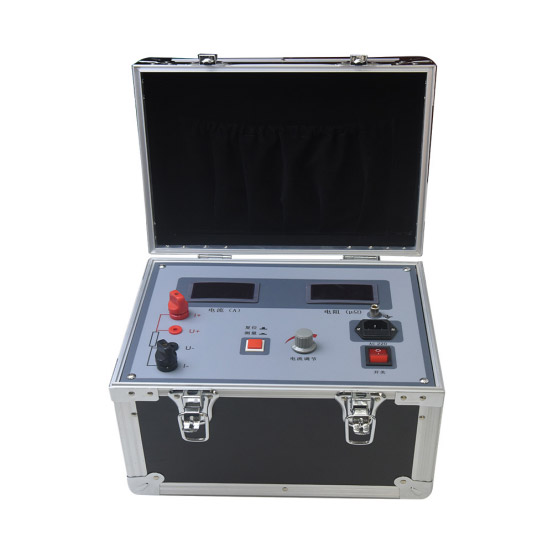
In a specific case, the preventive test of a 500KV substation high-voltage circuit breaker used this tester instead of the traditional DC bridge, accurately measuring the circuit resistance of the μ Ω level at 100A current, effectively preventing the occurrence of contact heating defects. This test result confirms the technical path of combining high current output with high-precision measurement, which has verifiable practical effects under real working conditions.
After sales service system
Wuhan Yueneng Gaoce Power Equipment Co., Ltd.'s products come with a relatively complete after-sales service commitment: within three months from the date of shipment, if there are any defects in the products, they will be replaced; Free maintenance will be implemented within one year, and paid lifelong maintenance will be provided for more than one year, which will be handled by dedicated maintenance personnel or returned to the company's after-sales service department. This service system provides support for the long-term use of equipment and to some extent reflects the confidence of production enterprises in product quality.
Conclusion
Overall, the 100A circuit resistance tester focuses on the industry challenge of breakdown of oxide film on high-voltage switch contacts. Through high-frequency switching power supply technology, it achieves continuous high current output and combines four wire testing, digital dual display and other functional designs to achieve a balance between measurement accuracy, anti-interference ability and on-site applicability. For power and supply departments, high-voltage switch manufacturers, and related scientific research units that need to carry out preventive testing, quality inspection and acceptance, or operation and maintenance testing of high-voltage equipment, this equipment provides a testing solution that meets current standards and is supported by actual test cases. It is worth paying attention to in the equipment selection process.



 Enter the mobile station